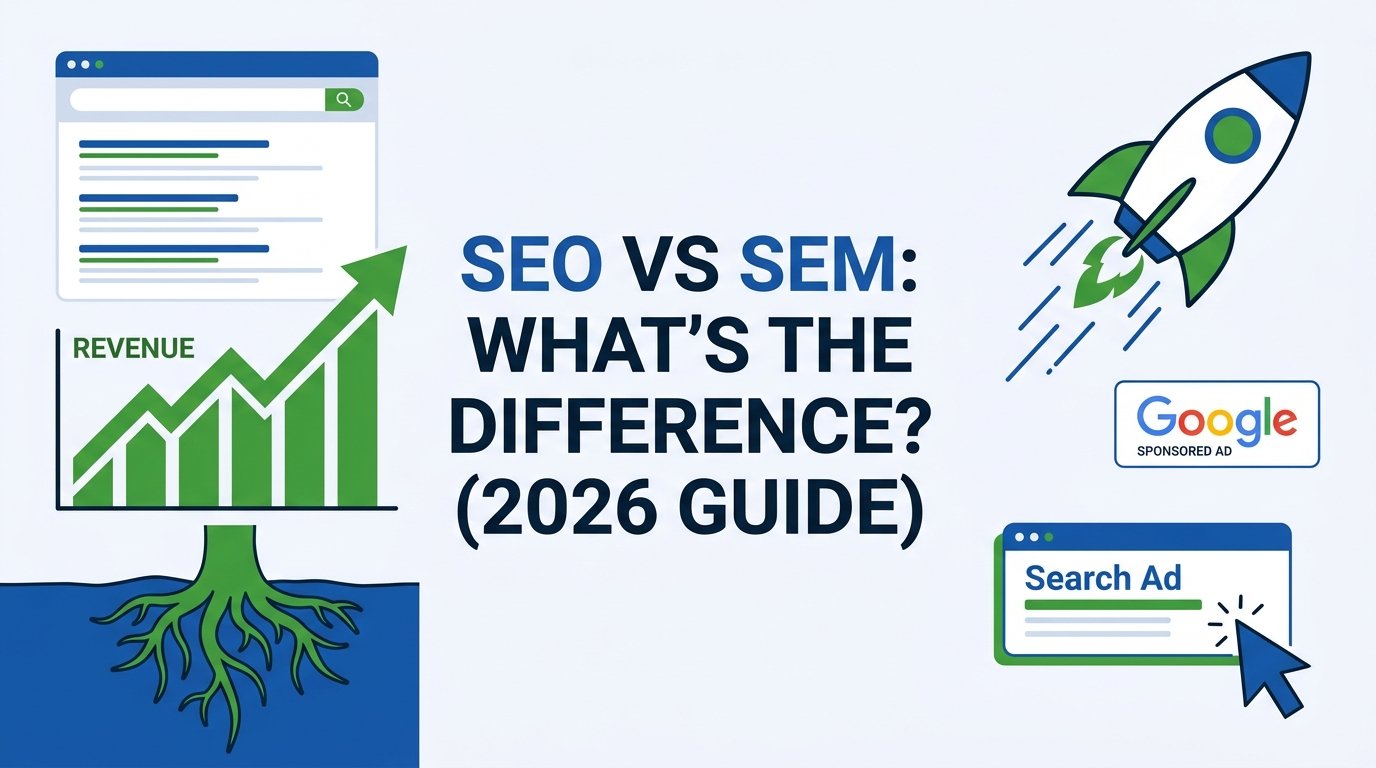
SEO (Search Engine Optimisation) is the practice of earning free, organic rankings in search results through content, technical improvements and backlinks. SEM (Search Engine Marketing) is paid advertising on search engines — buying placement instead of earning it, most commonly through Google Ads. SEO is slower and compounds over time; SEM is instant but stops the moment you stop paying.
The Core Difference, in One Line
Everything else about how the two search strategies differ follows directly from that foundational distinction.
Side-by-Side Comparison: SEO vs. SEM
| Feature | SEO (Organic Search) | SEM (Paid Search / Ads) |
|---|---|---|
| Cost Model | No direct cost per click; investment goes into content, technical foundation & link equity | Pay-per-click (PPC) — you pay every time someone clicks your ad |
| Speed to Results | Typically 3–6 months for meaningful ranking traction | Live and generating clicks within hours of campaign launch |
| Longevity & Compounding | A well-ranked page keeps earning traffic for months and years | Traffic stops immediately the moment your ad budget runs out |
| Where It Appears | Organic results & Google Maps 3-Pack, below paid ads | Labelled "Ad" or "Sponsored," positioned at the very top of search feeds |
| Trust Perception | Higher editorial trust; seen as earned and credible | Transparently commercial; 60%+ of users actively scroll past ads |
| Level of Control | Indirect — algorithms evaluate hundreds of ranking signals | Direct — full control over ad copy, bid amounts, and landing pages |
| Best Suited For | Long-term, sustainable customer acquisition and ROI | Immediate pipeline generation, keyword testing, time-limited promotions |
| Skill Required | Technical SEO, schema markup, content clusters, PR backlinks | Keyword bidding strategy, Quality Score optimization, ad copywriting |
What SEO Actually Involves
SEO covers three broad disciplines working in synergy:
Content quality, search intent alignment, keyword research, heading structure, and logical internal linking on your own website.
Core Web Vitals, server response speed (TTFB), mobile responsiveness, crawl budget optimization, and JSON-LD structured data schema.
Authoritative backlinks, digital PR coverage, and trade citations that signal entity authority and trust to search engines.
None of these buy you a position. They earn one, based on how search engines evaluate relevance and authority — which is exactly why SEO takes longer but doesn't disappear the moment you stop actively working on it.
What SEM Actually Involves
SEM is most commonly associated with Google Ads, though it covers paid search generally. It operates on an auction-based mechanism: you bid on target keywords, set daily or monthly budgets, craft ad headlines and descriptions, and pay each time a searcher clicks through.
Ad position is determined by your bid amount combined with your Quality Score — Google's rating of how relevant your ad and landing page are to the user's search query. This means a well-structured, hyper-relevant ad campaign can outrank a competitor with a much bigger budget spent carelessly.
However, the moment your budget is exhausted or the campaign is paused, traffic ceases instantly. There is zero residual lead generation once ad payments stop.
Which One Should You Use First?
The decision depends entirely on your immediate cash flow, commercial timeline, and risk tolerance — not on one channel being objectively superior.
Choose SEM First If:
- You need immediate customer inquiries — an early-stage business with an empty calendar cannot wait 4 months for organic traction.
- You want to test which keywords, offers, and value propositions convert before committing to lengthy content production.
- You are running time-sensitive promotions, seasonal sales, or limited-capacity launches.
Choose SEO First If:
- You are building a compounding asset for the long term and have baseline cash flow to support the foundation phase.
- Your industry has exorbitant cost-per-click rates (£25–£60+ per click in roofing, legal, or renewable energy) where perpetual PPC is unsustainable.
- You want organic search traffic that continues to deliver inbound inquiries without paying for every single click.
A Common Misconception Worth Clearing Up
Paying for Google Ads does not directly improve your organic SEO rankings, and achieving top organic positions does not reduce what Google charges you per click in Google Ads.
The two systems operate independently within Google's architecture. The true synergy between them is strategic, not algorithmic: conversion data from SEM campaigns (identifying exactly which high-intent search terms generate paying clients) directly informs your local SEO content strategy.
SEO and SEM in the Age of AI Search (GEO & AEO)
Search behavior has shifted fundamentally. A growing percentage of user queries now resolve within conversational AI tools — ChatGPT, Perplexity, Gemini, and Google AI Overviews — before a user ever clicks a blue link.
This development impacts organic search profoundly: winning citations in AI answers (Generative Engine Optimization or GEO) depends on technical schema, factual consistency, and verified entity signals. While paid ad units are emerging inside AI answer interfaces, the fundamental dynamic remains unchanged: you will either earn visibility through authority or pay for placement.
Common Mistakes Businesses Make with Each
- Expecting top-3 rankings within 3 weeks and abandoning the strategy prematurely.
- Targeting broad informational keywords with zero commercial buying intent.
- Neglecting technical Core Web Vitals and mobile UX.
- Treating SEO as a one-time setup rather than an ongoing competitive asset.
- Directing expensive paid traffic to an unoptimized homepage instead of a focused landing page.
- Bidding on broad-match terms without a comprehensive negative keyword list.
- Terminating campaigns prematurely before sufficient statistical data accumulates.
- Failing to set up server-side conversion tracking.
How Marketing Budget Should Shift Over Time
Think of your SEO and SEM allocation as a dynamic scale that rebalances as your domain gains organic authority:
SEM: 70% (Immediate revenue generation) | SEO: 30% (Technical & content foundation)
SEM: 40% (Targeted high-ticket terms) | SEO: 60% (Geo-silos & link acquisition)
SEM: 20% (Brand defense & promotions) | SEO: 80% (Passive, compounding organic pipeline)